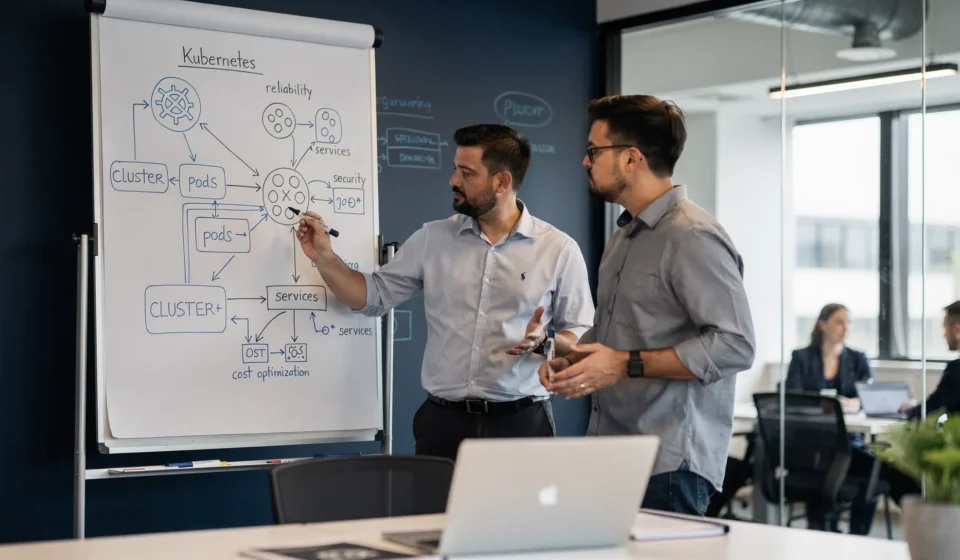

Learn how to build a Kubernetes-focused engineering team. Techlynx Recruiters connects you with software developers and cloud engineers.
Table of Contents
How to Build a Kubernetes-Focused Engineering Team That Scales
Key Insights Box (TL;DR)
- A Kubernetes-focused engineering team needs specialized roles, not generalist hires
- Platform thinking beats cluster administration every time
- Security and developer experience belong in the design, not the audit
- Techlynx Recruiters helps US companies hire software developers and cloud engineers
- Elite teams treat the cluster as a product with users, budgets, and roadmaps
How to Build a Kubernetes-Focused Engineering Team That Ships Reliably
To build a Kubernetes-focused engineering team, hire for platform engineering, reliability, security, and developer experience rather than cluster administration alone. Define role boundaries, test real production judgment, and staff for ownership. Teams that treat the cluster as an internal product ship faster and break less.
Here is the reality: Kubernetes is not hard to install. It is hard to operate. Most US companies discover this after their first production outage, when a generalist team cannot explain why pods keep restarting.
The best part? You can avoid that pain entirely. The right team structure prevents most of it before it starts.
Look: A Kubernetes-focused engineering team is not a group of people who know kubectl. It is a group of people who own a platform.
Why a Dedicated Kubernetes Team Beats Generalist Hiring
Generalist engineers can run a cluster. They cannot run it well at scale.
Here is why: Kubernetes concentrates complexity. Networking, storage, identity, autoscaling, and deployment strategy all intersect in one control plane. Each area needs depth.
When you build a Kubernetes-focused engineering team, you distribute that complexity across specialists. When you hire generalists, one person absorbs it all and becomes a bottleneck.
Look at the symptoms of a weak team. Slow rollouts. Manual intervention. Mystery costs. Developers who avoid the platform entirely.

The Definition Box: What a Kubernetes-Focused Engineering Team Means
A Kubernetes-focused engineering team is a group of specialists who design, operate, and improve a container platform built on Kubernetes. The team owns cluster lifecycle, workload delivery, security posture, observability, and developer experience. Its goal is reliable, self-service deployment rather than manual cluster management.
The Contrarian Expert Tip: Hire for Platform, Not Cluster
Here is my controversial take: Stop hiring Kubernetes administrators. Start hiring platform engineers.
Why? Administration is a task. Platform thinking is a discipline. Administrators keep the cluster alive. Platform engineers make developers productive.
Ask candidates how they measured adoption of their platform. Ask what developers complained about most. Ask which self-service features they shipped. Administrators go quiet. Platform engineers tell stories.
That distinction separates a Kubernetes-focused engineering team that accelerates delivery from one that becomes a ticket queue.
The Core Roles You Must Hire
Platform Engineers
Platform engineers build the internal product. They design abstractions that hide cluster complexity from application teams.
- Custom resource definitions for common workloads
- Helm or Kustomize based delivery patterns
- Namespace and multi-tenancy design
- Cluster upgrade and lifecycle automation
Deep Detail: Abstraction Boundaries
Strong platform engineers know when to abstract and when to expose. Over-abstraction creates escape hatches everywhere. Under-abstraction pushes complexity onto developers. Evaluate this judgment carefully.
Reliability Engineers
Reliability engineers own availability, capacity, and incident response.
- Autoscaling policy design and tuning
- Resource requests and limits discipline
- Pod disruption budgets and rollout safety
- Capacity planning and cost control
Deep Detail: Failure Domain Thinking
Ask candidates to map failure domains in your design. Node, zone, and cluster level failures each need different handling. Weak candidates answer in generalities. Strong ones describe specific blast radius limits.
Security Engineers
Security engineers embed guardrails into the platform itself.
- Pod security standards enforcement
- Network policy design and segmentation
- Secret management and workload identity
- Image scanning and supply chain verification
Deep Detail: Identity at the Workload Level
Elite engineers avoid long-lived credentials entirely. They use workload identity and short-lived tokens. Evaluate how candidates remove static secrets from the delivery path.
Application Developers
Your software developers must understand the platform they deploy to. Otherwise every deployment becomes a support request.
- Container image build best practices
- Health checks and readiness probes
- Configuration and environment separation
- Logging and metric emission standards
The Evaluation Framework That Reveals Real Ability
Cluster Design Scenarios
Present a multi-tenant requirement. Ask for namespace strategy, quota design, and isolation approach. Listen for tradeoffs, not buzzwords.
Incident Simulations
Describe a cascading failure. Watch how candidates isolate cause, protect critical workloads, and communicate under pressure.
Upgrade Planning Discussions
Ask how they would upgrade a production cluster without downtime. Strong answers cover deprecated APIs, workload compatibility, and rollback paths.
Cost and Capacity Conversations
Ask about spend visibility and right-sizing. Engineers who discuss efficiency signal maturity. Engineers who ignore cost signal risk.
Before and After: The Team Transformation
| Dimension | Generalist Approach | Kubernetes-Focused Team |
|---|---|---|
| Deployment Speed | Manual and slow | Self-service and fast |
| Incident Recovery | Extended and uncertain | Fast and rehearsed |
| Security Posture | Bolted on after audits | Built into the platform |
| Developer Experience | Frustration and workarounds | Adoption and autonomy |
| Cost Control | Opaque and rising | Visible and optimized |
The Open Loop: What Elite Kubernetes Teams Understand
Earlier I mentioned a critical insight. Here it is: A Kubernetes-focused engineering team succeeds or fails on trust.
But here is the deeper truth: Trust is built through paved roads and fast feedback. When developers deploy safely without asking permission, trust grows. When every change requires a ticket, trust dies and shadow systems appear.
When you build a Kubernetes-focused engineering team, hire people who remove friction. They measure adoption. They interview their internal users. They treat the platform roadmap like a product roadmap.
Why Techlynx Recruiters Helps US Companies Build These Teams
Techlynx Recruiters understands the mix of roles required to build a Kubernetes-focused engineering team. We screen for production ownership, not certification counts.
Our candidates include software developers and cloud engineers who have:
- Operated multi-tenant clusters in production
- Designed platform abstractions and self-service workflows
- Implemented workload identity and network policy
- Handled upgrade paths without customer impact
- Instrumented observability across workloads
We evaluate judgment through scenarios, not trivia.
Frequently Asked Questions
What roles belong in a Kubernetes-focused engineering team?
Platform engineers, reliability engineers, security engineers, and application developers. Each role owns a distinct domain while sharing responsibility for developer experience and platform stability.
Do I need specialized hires or can generalists learn Kubernetes?
Generalists can learn the basics. Depth in networking, storage, identity, and scaling requires specialists. A Kubernetes-focused engineering team mixes specialists with developers who understand the platform.
How do I evaluate Kubernetes experience in interviews?
Use cluster design scenarios, incident simulations, upgrade planning, and cost discussions. Look for specific production stories rather than tool lists.
Why does developer experience matter so much?
Developers are the platform users. Poor experience drives workarounds and shadow deployments. Strong experience increases adoption, speed, and reliability across the organization.
How does Techlynx Recruiters screen Kubernetes talent?
We use practical scenarios covering platform design, failure handling, security, and observability. We verify production ownership before presenting candidates to US companies.
The Challenge of Platform Hiring
Building a Kubernetes-focused engineering team requires clarity about roles, evaluation, and ownership. Vague requirements produce vague hires. Precise requirements produce platforms that scale.
When US companies get this right, deployments become routine. Incidents become shorter. Developers stop fighting infrastructure and start shipping features.
Final Thought
The best Kubernetes teams are not the ones with the most certifications. They are the ones with clear ownership, self-service platforms, and engineers who respect their users.
Choose specialists who build paved roads. Choose engineers who measure adoption. Choose people who make the platform invisible.
Build Your Platform Team with Confidence
Techlynx Recruiters helps US companies build a Kubernetes-focused engineering team that ships reliably. We connect you with software developers and cloud engineers who deliver from day one.
Ready to build a Kubernetes-focused engineering team?
Contact us today at +1(307) 449-2132 or +1(572) 234-1869 and discover how our specialized screening finds platform talent for American tech teams. Our rigorous evaluation ensures you hire engineers who own outcomes. Your next great platform engineer is waiting. Reach out now and build the team your infrastructure deserves.